If you are considering buying 100 acres of wooded land, you may look at the asking price and calculate a simple price per acre. But that doesn't necessarily tell you what you're buying.
Two neighboring 100-acre properties can have dramatically different values if one contains mature, merchantable timber and the other contains recently harvested or young timber. That's where a timber cruise before buying land can become an important part of your due diligence.
A timber cruise helps estimate what is actually growing on the property — including the species, size, quantity and potentially the value of the standing timber. For someone buying timberland as an investment, recreational property, hunting land or part of a larger farm, that information can significantly change how a property should be evaluated.
What Is a Timber Cruise?
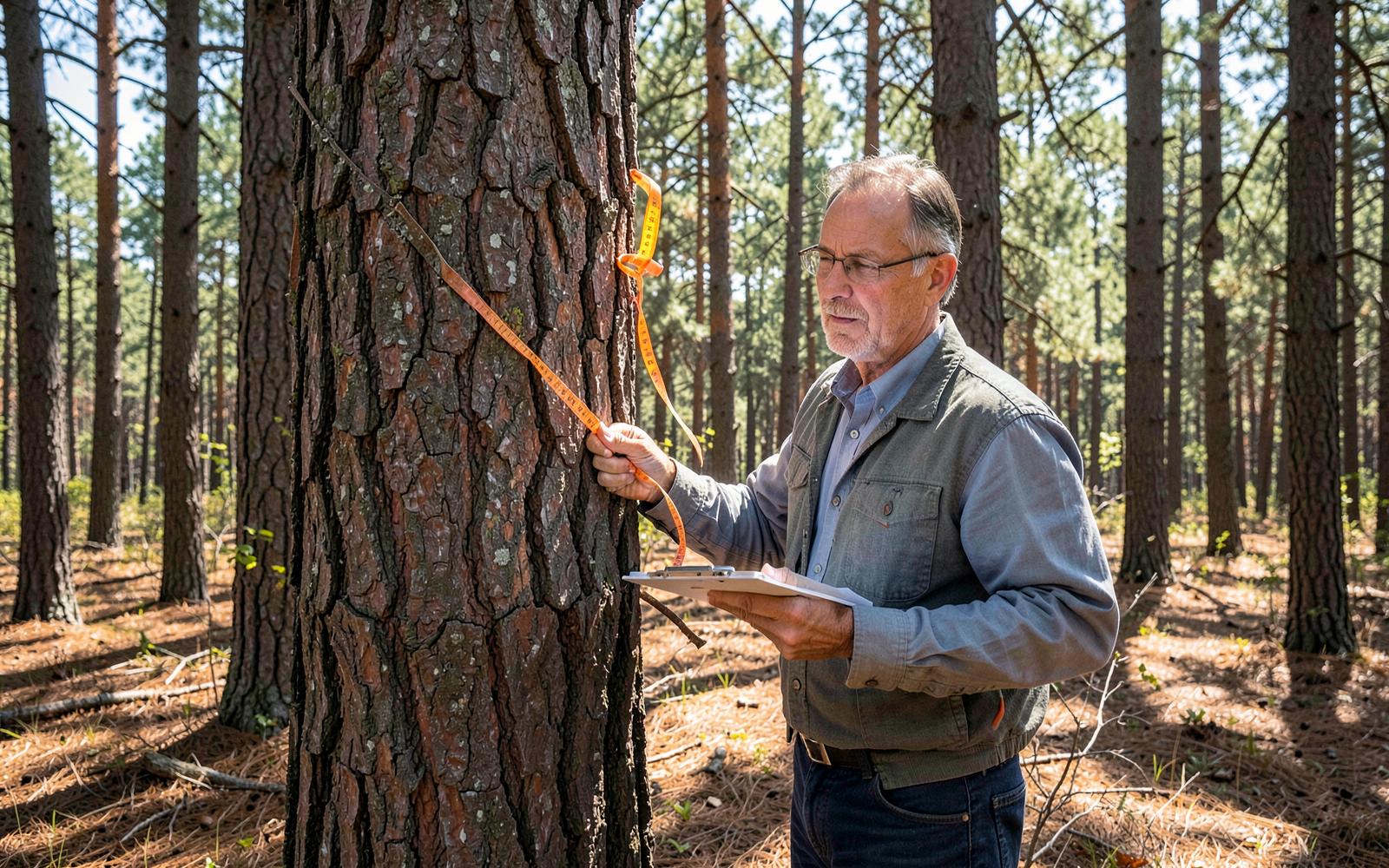
A timber cruise is essentially an inventory of the trees growing on a property. The Virginia Department of Forestry defines a timber cruise as a forest survey used to assess factors such as wood volume, value and species composition.
Rather than measuring every tree on hundreds or thousands of acres, a professional forester typically measures representative samples throughout the property. Clemson University's Land-Grant Press explains that forest sampling allows a forester to measure a subset of trees and use that information to estimate characteristics of the entire forest.
What Does a Timber Cruise Measure?
Depending on the purpose and scope of the cruise, a forester may collect information including:
- Tree species
- Tree diameter
- Tree height
- Number of trees per acre
- Timber volume
- Timber quality
- Product classification
- Age and condition of timber stands
- Estimated merchantable timber
For example, a tract might contain a combination of pine pulpwood, chip-n-saw, pine sawtimber and hardwood sawtimber. Those categories don't necessarily have the same economic value. A property advertised as having "mature timber" therefore doesn't tell you enough to determine what that timber may actually be worth.
How Does a Timber Cruise Work?
A timber cruise usually does not involve measuring every tree. Instead, the forester establishes sample locations throughout the property and measures trees within those areas. The University of Florida's forestry extension program explains that timber cruising generally involves sampling part of a forest and expanding those samples into estimates for the entire stand.
The forester might measure the diameter and height of trees at numerous sample points, then use those measurements to estimate timber volume across the property. That is considerably different from someone walking the tract and guessing that "there's probably $200,000 worth of timber out here." A cruise attempts to replace that guess with measurable data.
Timber Cruise vs. Timber Valuation
Here's an important distinction for land buyers: a timber cruise doesn't necessarily tell you exactly what the timber is worth. It may primarily tell you what timber is there.
Oregon State University Extension distinguishes between a timber cruise and a timber valuation. A cruise can provide information such as volume, species, grade and other characteristics, while a valuation goes another step by estimating the timber's monetary value.
So if you are purchasing property specifically because of its timber investment potential, ask the forester exactly what the final report will include. You may want both timber inventory and estimated timber value rather than inventory data alone.
Do You Need a Timber Cruise Before Buying Land?
Not necessarily. But the more important the timber is to the property's value or your investment strategy, the stronger the case becomes for obtaining one. Consider two examples.
Property A
Purchase price of $750,000 for 150 acres, where most of the timber was harvested several years ago. You are primarily buying the land for hunting and recreation. Future timber may have value, but it isn't a major reason you're purchasing the property.
Property B
Purchase price of $1,500,000 for 300 heavily wooded acres. The seller indicates that a substantial amount of mature pine and hardwood timber is present, and part of your investment thesis is that future harvests will generate income.
In the second situation, understanding the timber inventory becomes much more important. You don't want to pay a premium for timber that isn't actually there — or discover after closing that the timber is significantly younger, lower-quality or less merchantable than you assumed.
Why a Timber Cruise Matters When Buying Timberland
1. Determine What You're Actually Buying
Aerial photographs can show you that a property is wooded. They can't tell you the economic value of those trees. A timber cruise helps answer a much more important question: what's actually standing out there?
2. Evaluate the Purchase Price
Suppose you're considering purchasing 500 acres for $2 million — $4,000 per acre. If a professional evaluation indicates the tract also contains substantial merchantable timber, that information may change how you think about the price. Conversely, if you assumed there was significant merchantable timber and the cruise shows otherwise, you may look at the transaction very differently.
3. Plan Future Timber Income
Some timberland investors aren't simply hoping the land appreciates — timber itself is part of the investment. Depending on the property and management strategy, revenue could eventually come from thinning or final harvests. A timber inventory provides information that helps the buyer and their forestry professionals develop a management strategy.
4. Identify Different Timber Stands
A 500-acre property isn't necessarily one uniform forest. It might contain:
- 150 acres of mature pine
- 100 acres of younger planted pine
- 75 acres of mature hardwood
- 100 acres of mixed timber
- 75 acres of fields, roads, wetlands and other areas
Those components may have very different economic characteristics. Understanding the property stand-by-stand can provide a much clearer picture of the asset you're considering.
Don't Confuse Timber Value With Land Value
The land has value. The timber growing on the land may have additional value. But the two aren't interchangeable. A property's overall market value can also be influenced by many other factors, including:
- Location
- Road frontage
- Access
- Topography
- Soils
- Water
- Easements
- Development potential
- Recreational appeal
- Hunting quality
- Nearby land uses
That's why a timber cruise should not automatically be treated as a substitute for a real estate appraisal. It answers a different question.
What About Buying Land With Mature Timber?
"Mature timber" sounds valuable in a real estate listing, but mature doesn't automatically mean highly valuable. Actual economic value can depend on species, size, quality, volume, accessibility, local timber markets and the products that can be produced from the trees.
Logging conditions matter as well. A beautiful stand of timber isn't necessarily worth the same amount if harvesting and transporting it is unusually difficult. That's another reason to involve an independent forestry professional when timber represents a meaningful part of your purchase decision.
Who Should Perform the Timber Cruise?
For a significant land purchase, consider hiring a qualified consulting forester who represents your interests as the buyer. Oregon State University Extension recommends looking for experienced forestry professionals and specifically notes the importance of avoiding conflicts of interest when selecting someone to conduct a cruise. Ask potential foresters about:
- Their forestry experience
- Experience with similar properties
- Their sampling methodology
- What the final report includes
- Whether estimated timber value is included
- Their knowledge of local timber markets
- References
- Their fee structure
Most importantly, explain why you're ordering the cruise. A cruise designed to prepare an immediate timber sale may not be identical to the information an investor needs when evaluating the purchase of an entire timber property.
Should You Get a Timber Cruise During the Due Diligence Period?
When possible, yes. If timber value is important to your decision, don't wait until after closing to find out what you bought. A timberland buyer might work through property boundaries, title, legal access, survey, environmental issues, timber inventory, timber value, financing and appraisal. The appropriate process will vary by transaction, but the key is to identify major uncertainties before your contractual due diligence rights expire.
Can a Timber Cruise Help With Financing?
Potentially — but a timber cruise and a lender's appraisal are not necessarily the same thing. When financing timberland, lenders generally need to understand the value of the real estate securing the loan. Depending on the transaction, the appraisal may consider the property's timber characteristics as part of the overall collateral analysis.
However, borrowers shouldn't assume that $500,000 of estimated timber automatically translates into an additional $500,000 of lendable collateral. The lender still has to consider appraised value, loan-to-value requirements, repayment capacity, liquidity, credit profile and the overall structure of the transaction.
What If You Plan to Harvest Timber After Closing?
Tell your lender. This is especially important when the timber contributes meaningfully to the value of property securing a loan. A borrower shouldn't assume they can purchase heavily timbered property with financing, immediately harvest a large portion of the timber and retain all of the proceeds without discussing it with the lender. Depending on the loan documents and collateral structure, harvesting may require lender approval or affect how proceeds are handled. Discuss that plan during the financing process — not after closing.
A Simple Example
Imagine two 250-acre properties. Tract #1 is priced at $1,250,000, or $5,000 per acre, with unknown timber value. Tract #2 is priced at $1,500,000, or $6,000 per acre, with a timber evaluation indicating substantial merchantable timber.
At first glance, Tract #1 looks cheaper. But price per acre alone doesn't tell the entire story. If Tract #2 contains significantly more valuable timber, better access and a stronger long-term management profile, the higher-priced property could represent the better investment. That's precisely why timberland investors shouldn't evaluate wooded property solely on price per acre.
Questions to Ask Before Buying Timberland
- Has the property had a recent timber cruise?
- Who performed it?
- When was it completed?
- What species are present?
- How many acres are actually timbered?
- What is the estimated merchantable volume?
- Is a timber valuation included?
- When was the property last harvested?
- Is there a forest management plan?
- Are timber rights included with the property?
- Are there access or environmental issues affecting harvesting?
- Is future timber income part of my repayment plan?
- Does my lender know about any planned timber harvest?
The answers can help you better understand both the land and the financing request.
The Bottom Line
A timber cruise before buying land isn't necessary for every rural property purchase. But when standing timber represents a meaningful portion of the property's value — or timber income is an important part of your investment strategy — it can be valuable due diligence.
A professional timber cruise can help you understand what timber is actually present, while a timber valuation can take the analysis further by estimating its potential economic value. For buyers, the objective is simple: know what you're buying before you finance it.
Financing Timberland or Rural Property?
FieldService Capital helps borrowers evaluate financing options for agricultural land, timberland, farms, ranches and other rural properties. Whether you're purchasing a timber tract, refinancing existing rural real estate or using land equity to fund another investment, the right structure depends on the property, borrower and intended use.
This article is for general educational purposes and should not be considered financial, tax, legal, appraisal or forestry advice. Buyers should consult qualified professionals regarding their specific transaction.