Buying 20 acres may still look like a residential transaction. Buying 2,000 acres usually doesn't — and trying to finance it like one can derail an otherwise strong deal.
A large rural property can be many things at once. It can be a working farm, a cattle ranch, a timber investment, a hunting property, a recreational retreat, a long-term land investment, or a combination of all of them. That flexibility is part of what makes agricultural real estate attractive. It is also what makes large acreage loans very different from ordinary residential mortgages.
A buyer may have excellent credit, substantial liquidity and strong income and still discover that a conventional mortgage lender has little interest in financing a 500-acre farm, a 1,200-acre timber tract or a 2,000-acre hunting property. The problem may not be the borrower. It may be the property.
Traditional mortgage underwriting is largely designed around houses. Large-acreage financing is built around something more complicated: the land itself, its use, its income potential, its marketability and the borrower's ability to support the debt over time.
What Is a Large Acreage Loan?
A large acreage loan is financing used to purchase, refinance or improve a substantial tract of land. There is no universal definition of "large acreage." To one lender, 50 acres may be considered substantial. To another, a 500-acre farm may be routine. What matters is less the exact acreage and more the nature of the property.
Large land loans commonly finance:
- Row-crop farms
- Cattle and livestock ranches
- Timberland
- Hunting properties and recreational acreage
- Orchards and permanent plantings
- Rural estates
- Undeveloped agricultural land
- Land held for long-term investment
- Multiple adjoining or noncontiguous parcels
- Properties combining agricultural and recreational uses
Some transactions involve a residence; others do not. A conventional mortgage lender usually wants the residence to be the primary source of collateral value. A lender experienced in agricultural and rural real estate is often more comfortable when the land itself is the primary asset.
Why Large Acreage Financing Is Different From a Home Mortgage
Suppose you are buying a house on five acres. The lender can compare the property with nearby residential sales, order a residential appraisal and evaluate your income using familiar mortgage guidelines.
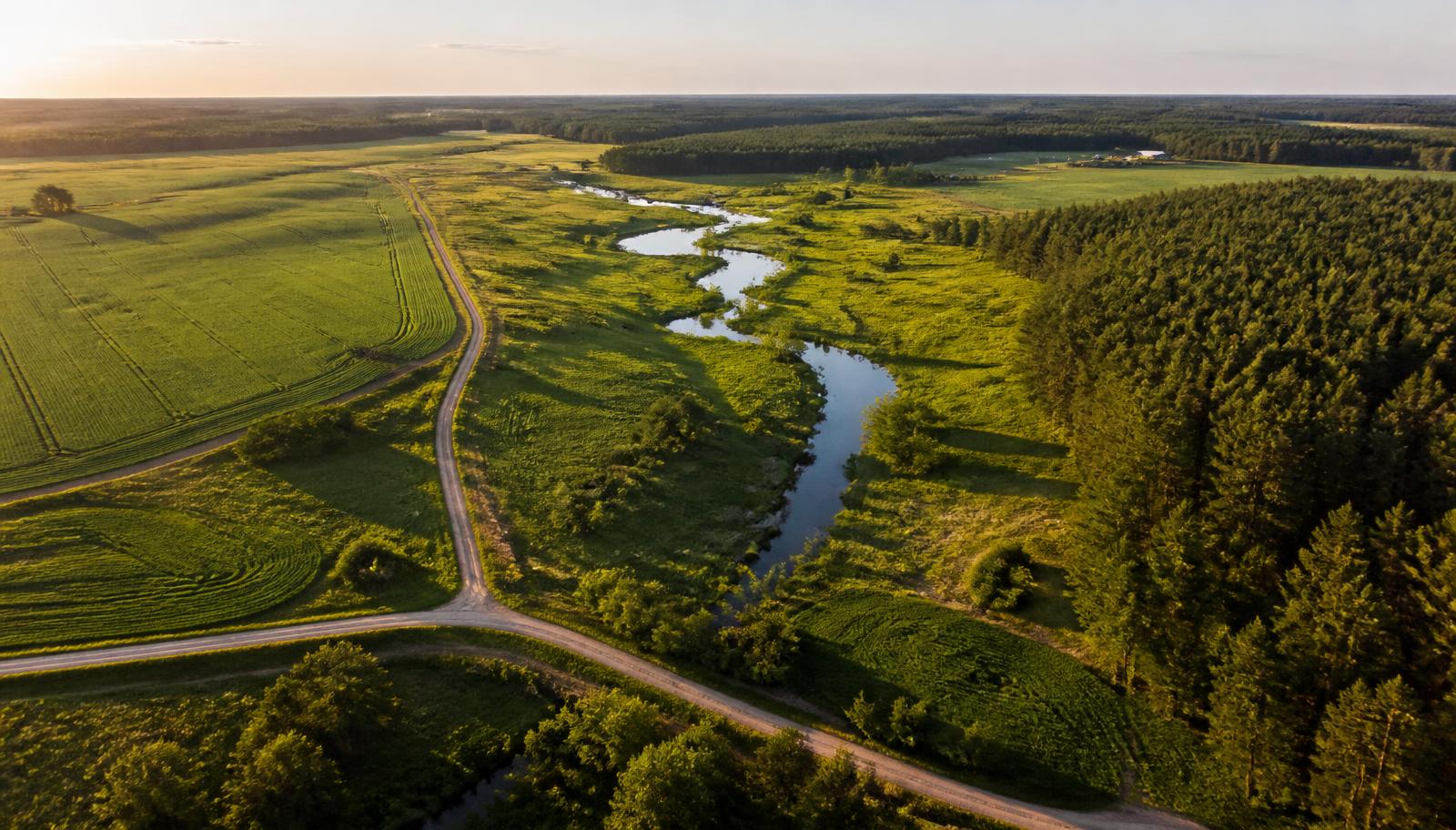
Now suppose you're buying 800 acres. Perhaps 300 acres are cropland, another 250 acres are timber, and there are two ponds, several miles of interior roads, a hunting lease, agricultural improvements and an older farmhouse. The property may generate farm income. The timber may have merchantable value. The recreational component may influence market demand. Some acreage may be wetlands. Access could cross neighboring property. There may be conservation restrictions or easements.
The First Question: What Will the Land Actually Be Used For?
Before talking about loan terms, a lender usually needs to understand the purpose of the property. The same 500 acres can look very different depending on how the buyer intends to use it.
Farming
- Crop and livestock income
- Historical yields and commodity prices
- Operating expenses and leases
- Government program income
- Farm management experience
- Existing agricultural debt
Investment
- Appreciation and timber growth
- Lease income
- Conservation value
- Future development potential and parcel splits
- Long-term hold strategy
Recreation
A recreational property may produce little direct cash flow. Financing may depend much more heavily on the borrower's outside income, liquidity and overall financial strength. Hunting leases or timber income may help, but they may not be sufficient to service the debt.
Mixed Use
Many large properties fall in between. A buyer may purchase 1,000 acres to farm 400 acres, lease 300 acres, manage timber on another 200 acres and use the remainder for hunting. A lender familiar with agricultural real estate can often evaluate those components together rather than forcing the property into a single category.
Can You Get a Loan for 100 Acres?
Yes. A loan for 100 acres is very common in rural lending, but the structure depends heavily on the property. A 100-acre tract with a primary residence may fit certain residential or rural housing programs. A 100-acre operating farm may be treated as agricultural real estate. A 100-acre timber tract or hunting property may be underwritten primarily as land.
The lender will typically evaluate purchase price, appraised value, down payment, borrower income, credit history, liquidity, property use, existing debt, repayment capacity and marketability. Acreage alone rarely determines approval — there is usually no specific "100-acre loan program."
What About a Loan for 500 Acres?
Once you move into several hundred acres, financing typically becomes more specialized. A loan for 500 acres might involve a commercial bank, an agricultural real estate lender, a Farmer Mac lender, a private credit provider, an insurance company agricultural lender or a specialty rural lender.
Different lenders have different appetites. One may be comfortable with row-crop land but not recreational land. Another may specialize in ranches, investment-grade farmland or timberland. That is one reason borrowers receive dramatically different responses from different institutions — it may simply mean the property doesn't fit that lender's box.
Financing 1,000 Acres or More
A loan for 1,000 acres can become a very different type of transaction. At this size, lenders may examine the property more like an investment asset than a traditional piece of real estate. The analysis can include:
- Multiple income streams and farm leases
- Timber inventories and crop history
- Grazing capacity and water access
- Conservation easements and mineral rights
- Agricultural improvements and irrigation systems
- Multiple parcels and access agreements
- Environmental considerations
- Long-term land appreciation
Borrower financial strength also becomes increasingly important. A lender may want to see substantial liquidity after closing, not simply enough cash to make the down payment. The real question becomes: what happens if the property doesn't perform as expected for two or three years?
How Much Down Payment Do Large Acreage Loans Require?
It depends. Large acreage loans are usually based on loan-to-value (LTV). If a lender is comfortable financing 70% of a $2 million property, the maximum loan based purely on collateral might be roughly $1.4 million — implying about $600,000 in borrower equity.
Required equity varies with property type, borrower strength, credit quality, income stability, liquidity, agricultural experience, property cash flow, appraisal, location, loan size and intended use. A strong borrower purchasing productive farmland may receive different terms than someone buying undeveloped recreational land producing no income.
The Appraisal Can Make or Break the Deal
A residential appraisal compares houses with other houses. Large rural properties are more complicated. An agricultural appraiser may need to evaluate soil quality, tillable acreage, pasture, timber, water, improvements, road frontage, access, topography, irrigation, drainage, highest and best use, development pressure and comparable land sales.
The larger and more unusual the property, the harder it can be to find truly comparable sales. Valuing a 1,700-acre property with farmland, pine timber, hardwood bottoms, ponds, a hunting lodge and miles of roads may require an appraiser who understands the local land market — and a lender comfortable evaluating the resulting appraisal.
Land Value Is Not Always the Same as Purchase Price
Suppose you agree to pay $3 million for a large recreational property and the appraisal comes back at $2.6 million. If the lender finances 65% of value, the loan may be based on $2.6 million — not the contract price. That can suddenly increase the equity you need at closing, which is why experienced land buyers evaluate comparable land values before signing a contract.
Does the Land Have to Generate Income?
No. But someone still has to make the payments. For a working farm, that may be the agricultural operation. For an investment property, it might include lease income. For recreational acreage, repayment may come almost entirely from outside income.
Lenders evaluate repayment capacity by reviewing salary, business income, farm income, rental income, investment income, partnership distributions, existing debt payments and personal obligations. In agricultural lending, this broader analysis is often called global cash flow.
What Is DSCR?
Debt service coverage ratio (DSCR) compares cash available for debt service with required loan payments. If a borrower generates $150,000 available for debt service and total annual debt payments are $100,000, DSCR is 1.50x — $1.50 available for every $1 of debt service. At 1.00x there is virtually no cushion, and many lenders want margin above that. For recreational land with little income, lenders may lean more heavily on global cash flow.
Credit, Liquidity and Staying Power
Credit score matters, but it isn't everything. Lenders also weigh payment history, debt levels, net worth, liquidity, income stability, management experience, collateral and loan structure.
Liquidity matters enormously on large tracts. What happens if a crop fails, equipment breaks, timber prices weaken, interest expense increases, a tenant leaves, property taxes rise or the farm needs additional operating capital? Post-closing liquidity is what carries a borrower through those years.
Can Timber Help Support a Large Acreage Loan?
Potentially. Lenders may consider species, age class, merchantable volume, harvest schedule, timber markets, access and the management plan. A professional timber inventory or cruise supports the case. Treatment of timber as income versus collateral value varies by program.
Hunting and Recreational Land
Hunting and recreational properties — deer, duck, turkey, fishing, family recreation, conservation, weekend use and long-term appreciation — can absolutely be financed. Underwriting simply differs from an income-producing farm, leaning more on borrower income, liquidity, appraisal and intended use.
Multiple Parcels and Existing Land You Already Own
Adjoining or noncontiguous parcels can often be financed together under one facility, though appraisal, title and access work increases. If you already own other land, pledging additional collateral may improve overall LTV, reduce required cash equity, strengthen collateral coverage and provide additional lender comfort.
Rate, Term and Structure
Fixed or adjustable depends on holding period, the interest-rate environment, prepayment flexibility, cash flow and investment strategy. Amortization commonly runs 15, 20, 25 or 30 years, and a very common structure is a 30-year amortization with a 10-year maturity.
Borrowers understandably focus on rate, but structure may matter just as much: prepayment penalties, balloon maturity, amortization, fixed-rate period, collateral release provisions, reporting requirements, personal guarantees, advance rates and future borrowing flexibility. A loan that is 0.25% cheaper but prevents you from selling individual parcels could ultimately be far more expensive.
What Documents Will a Large Acreage Lender Ask For?
- Personal financial statement and tax returns
- Bank statements and debt schedules
- Entity and farm financial statements
- Purchase contract and property information
- Farm leases and rent rolls
- Production history and timber information
- Operating projections
Having organized information available early can make underwriting considerably smoother.
Should You Get Prequalified Before Making an Offer?
For large acreage, this can be extremely helpful. Imagine negotiating a $4 million land purchase and only later discovering your lender won't finance recreational acreage, requires 40% equity rather than 25%, or has a maximum acreage limitation. An early financing review can establish likely loan amount, estimated equity requirement, potential programs, cash flow considerations, property eligibility and expected documentation.
Why One Bank Says No While Another Says Yes
A decline does not always mean "this is a bad loan." Sometimes it means "this is not the kind of loan we make." Banks have geographic limits, loan-size limits, concentration limits, industry preferences, collateral requirements, regulatory considerations and internal credit policies. A community bank that mostly makes residential and small commercial loans may have little appetite for a 2,500-acre timber tract; an agricultural lender might consider it routine.
100 Acres, 500 Acres and 1,000 Acres: What Changes?
Financing 100 acres may still resemble a relatively straightforward land purchase, depending on use and improvements. At 500 acres, agricultural productivity, leases, timber, property income and borrower liquidity become increasingly important. At 1,000+ acres, transactions may require more sophisticated appraisal, financial analysis and structuring — sometimes resembling institutional real estate finance.
Five Things to Know Before Buying Large Acreage
- What is the land really worth? Understand comparable sales and local land values.
- How much equity can you comfortably contribute? The minimum isn't necessarily the right amount.
- Where will repayment come from — farm income, rent, salary, business income or investments?
- What will the property cost to carry? Taxes, insurance, maintenance and improvements continue after closing.
- What do you ultimately plan to do with the property — hold, farm, harvest, divide, build or sell parcels?
The Biggest Mistake Buyers Make
The biggest mistake is treating financing as an afterthought. Buyers spend months finding the perfect property — researching soil, walking timber, studying aerials, evaluating wildlife, negotiating price — and only after the contract is signed begin calling lenders. For a house that may work. For 1,000 acres it can be risky. When you're buying large acreage, the loan is not separate from the investment. It is part of the investment.
The Bottom Line
Large acreage financing is not simply a bigger version of a residential mortgage. A loan for 100 acres, 500 acres or 1,000 acres may require entirely different underwriting depending on the land, the borrower and the intended use. Lenders may evaluate collateral value, agricultural productivity, timber, lease income, outside income, global cash flow, liquidity, credit, management experience and long-term property strategy — and one of the most important factors may be choosing a lender that actually understands the asset.
Whether you're purchasing farmland to operate, timber for investment, or 1,500 acres because you've always wanted a place to hunt with your family, the property deserves financing built around what it actually is — not a house with too much land attached to it.
Financing is subject to lender underwriting, property eligibility, appraisal, credit approval and other requirements. FieldService Capital does not guarantee loan approval, rates, terms or funding. This article is provided for general educational purposes and should not be considered financial, legal or tax advice.