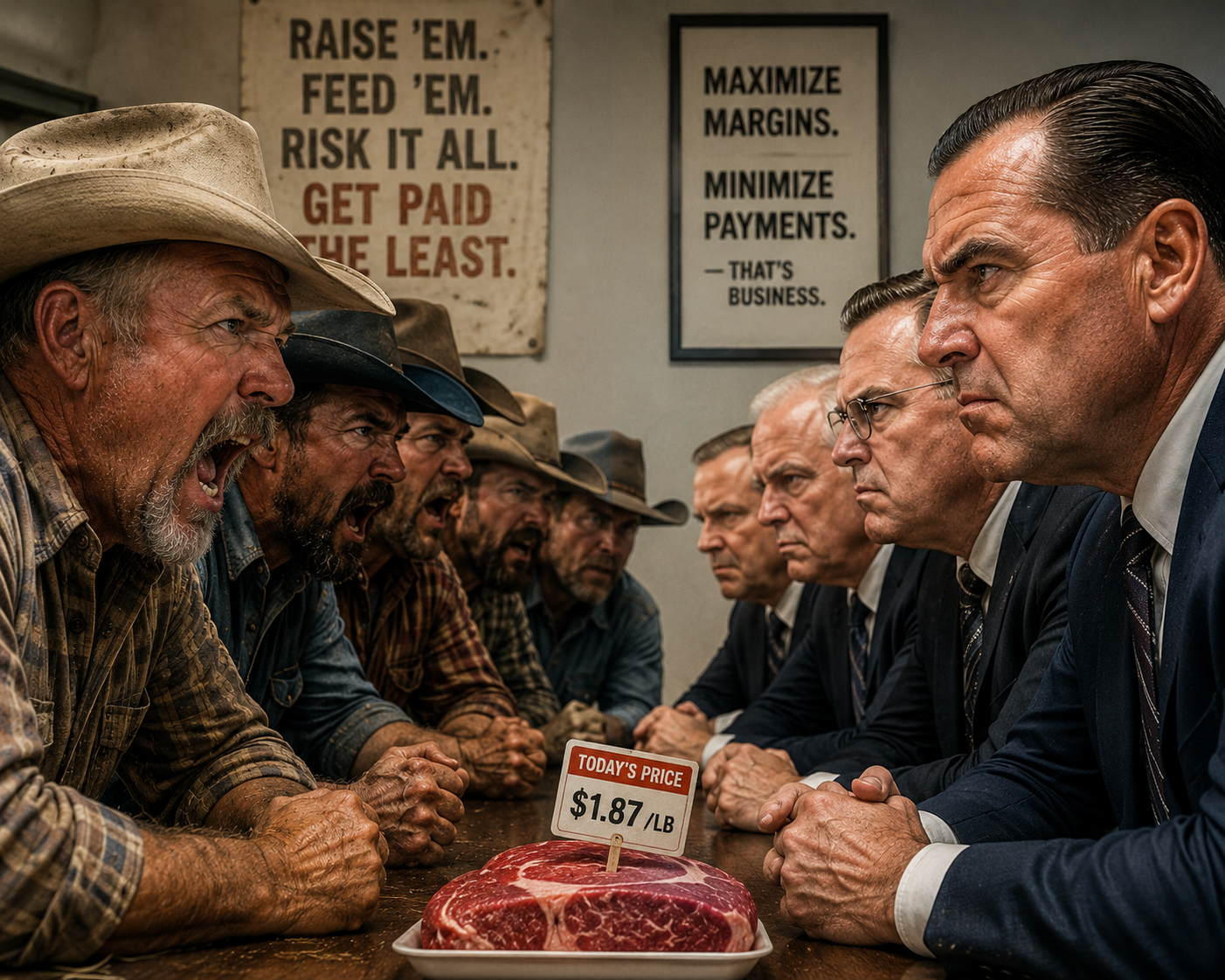
For generations, most American cattle producers have operated near the beginning of the beef supply chain. They raise the cattle. Someone else buys them. Someone else processes them. Someone else packages the beef. And someone else ultimately sells it to the consumer.
President Donald Trump is now proposing changes that could make it easier for farmers and ranchers to move farther down that supply chain by processing and potentially marketing more of their own beef.
In late August 2026, Trump said his administration was preparing legal action intended to give farmers and ranchers greater ability to process their own food. Agriculture Secretary Brooke Rollins subsequently indicated that the administration would pursue policies aimed at reducing regulatory barriers, supporting smaller processors and expanding opportunities to sell meat across state lines.
The idea comes as the American beef processing industry remains extraordinarily concentrated. USDA research has found that the four largest beef processors handle approximately 85% of steer and heifer purchases in the United States. Those companies are primarily Tyson Foods, JBS USA, Cargill and National Beef.
But what would happen if cattle producers began competing with them? Probably not what many people imagine. The future isn't likely to involve thousands of ranchers building slaughterhouses behind their barns. Instead, it could produce something much more interesting: a new network of producer-owned, cooperative and regional beef-processing businesses across rural America. And if that happens, it could create an entirely new category of agricultural investment.
Why Beef Processing Has Become Such a Big Issue
The beef industry has an unusual structure. There are cattle producers scattered throughout the country, but processing becomes increasingly concentrated as cattle move through the supply chain. USDA reports that the four largest beef packers' share of steer and heifer purchases increased from about 36% in 1980 to more than 80% by the mid-1990s, eventually reaching roughly 85%.
That doesn't automatically mean concentration is responsible for every problem in cattle markets. Large processing plants also created enormous efficiencies. USDA research has found that larger facilities reduced per-animal processing costs, and some of those efficiencies historically benefited consumers and livestock producers. At the same time, USDA says more recent evidence points toward reduced competition and lower cattle prices than might otherwise exist in certain circumstances.
What Rancher-Owned Beef Processing Could Look Like Initially
The first stage would probably be relatively modest. Rather than a 2,000-head cattle operation suddenly constructing a massive packing plant, we would likely see several models emerge.
1. Existing Small Processors Expand
This may be the fastest route. Independent USDA-inspected processors already exist throughout rural America. Many simply don't have enough capacity.
Government support could allow some of these businesses to add:
- Slaughter capacity
- Fabrication rooms
- Coolers and freezers
- Packaging equipment
- Wastewater systems
- Loading facilities
- Employees
- Distribution infrastructure
USDA is already moving in this direction. Its Strengthening Processing for U.S. Ranchers (SPUR) program makes up to $500 million available to eligible independent beef slaughter facilities. The four largest beef processors are specifically excluded from receiving these payments. USDA Rural Development has also announced another $60 million in Meat and Poultry Processing Expansion Program funding aimed at expanding processing capacity. Eligible projects can include producer-owned cooperatives and independent processors.
In other words, decentralization isn't merely theoretical. Infrastructure investment is already occurring.
2. Groups of Ranchers Could Build Cooperative Processing Plants
This is where things become especially interesting. Imagine 25 cattle producers within a 100-mile radius. Individually, none can justify constructing a processing plant. Together, they might.
Instead of: Rancher → Big Processor → Distributor → Retailer — the model becomes: Ranchers → Producer-Owned Processor → Retailer/Restaurant/Consumer.
The ranchers could collectively own the processing facility. One rancher might supply 400 cattle annually. Another supplies 800. Another supplies 150. Collectively, enough cattle could move through the facility to support a viable regional operation. The cooperative could potentially provide slaughter, fabrication, packaging, cold storage and distribution. That begins to change the economics dramatically.
3. Ranchers Could Capture More of the Value Chain
Consider what happens to one animal. A rancher currently sells a live animal. That animal ultimately becomes dozens of products: ribeyes, filets, briskets, ground beef, roasts, short ribs, organ meat, hides, tallow, bones, pet-food ingredients, and other byproducts. The producer normally receives the value associated with selling the animal—not the retail margin associated with everything that animal eventually becomes.
Vertical integration changes that. A producer-owned beef company could potentially participate in several stages: Raise → Process → Package → Brand → Distribute → Sell.
The Rancher Could Become a Beef Company
This may be the most important long-term consequence. Consider a hypothetical ranch called Pine Ridge Cattle Company. Today, Pine Ridge raises 1,500 cattle and sells them into the conventional cattle market. Under a vertically integrated model, Pine Ridge might eventually sell Pine Ridge Angus Beef directly to grocery stores, restaurants, butcher shops, food-service companies, institutions, and online consumers.
Consumers would increasingly recognize the ranch, rather than just the grocery store or meatpacking company. We already see pieces of this model in premium beef. But easier access to processing infrastructure could make it possible for far more producers.
The Bigger Opportunity May Be Regional Processing Hubs
Here's where the concept becomes much more economically significant. The future probably isn't: every ranch gets a slaughterhouse. It's: every major cattle-producing region gains access to competitive independent processing capacity.
Imagine a regional facility processing cattle for 50 or 100 producers. The plant might provide slaughter, fabrication, USDA inspection, vacuum packaging, cold storage, private-label branding, and distribution. The rancher doesn't necessarily have to become a meat processor. Instead, the rancher gains another place to take cattle. That alone could matter.
Could Ranchers Actually Compete With the Big Four Meatpackers?
Not directly—at least initially. The scale difference is enormous. Large packing plants can process thousands of cattle per day. Regional plants cannot easily match their operating efficiency. Agricultural economist David Anderson of Texas A&M told Reuters that he does not expect on-farm slaughter itself to materially alter the broader cattle market because the volumes would initially be too small. That's a legitimate limitation.
But the important question may not be whether independent processors replace Tyson or JBS. The question is whether producers gain another bidder for their cattle. Suppose a cattle-producing region currently has two practical buyers. Then a producer cooperative opens. Now there are three. Another independent processor expands. Now there are four. That additional competition could potentially matter more than the processor's national market share suggests.
Stage Two: Regional Beef Brands Begin Emerging
If processing capacity expands successfully, the next evolution could be branding. Think about how consumers buy wine. They don't simply buy "wine." They buy Napa Valley Cabernet. Agriculture could increasingly move toward similar geographic branding.
Consumers might encounter: South Carolina Pasture-Raised Beef. Texas Hill Country Beef. Montana Ranch Beef. Georgia Grass-Fed Beef. Dakota Angus Beef.
Regional processors could aggregate cattle from qualifying producers and develop recognizable brands. Instead of competing purely as a commodity, those producers could compete on origin, breed, feeding practices, sustainability claims, animal husbandry, quality, traceability and story. That could create a premium the commodity market doesn't always provide.
Stage Three: Technology Could Create a National Marketplace for Ranch Beef
Now take the idea another step. Imagine visiting an online marketplace and entering your ZIP code. You see 17 ranches that deliver beef to your area. You can compare ranch location, cattle breed, feeding program, processing date, price, USDA grade, customer reviews, and shipping availability. You select a ranch. The beef arrives two days later.
Processing and fulfillment could occur through regional facilities. The ranch doesn't need its own warehouse. The processing hub could handle processing, packaging, fulfillment, and shipping. Essentially: Shopify meets agricultural processing. That would allow even relatively small cattle operations to participate in national direct-to-consumer commerce.
Stage Four: Producer-Owned Processing Networks Could Become Large Businesses
Eventually, some regional cooperatives could consolidate. Imagine ten producer-owned plants across the Southeast. They share a brand, logistics, procurement, technology, marketing, and distribution contracts. Each plant remains regional, but collectively they have national scale.
Suddenly the system isn't a small butcher competing against Tyson. It's 5,000 ranchers collectively owning processing infrastructure. That's a very different competitor. And producer ownership creates an unusual economic structure: the cattle supplier and processing owner can effectively become the same economic party.
This Could Create Major Opportunities for Rural Capital
The biggest obstacle may not be cattle. It may be capital. A modern USDA-inspected processing operation can require significant investment in real estate, construction, equipment, refrigeration, wastewater treatment, working capital and distribution. That creates financing opportunities across rural America.
Potential projects could include:
- Meat processing plants
- Cold-storage facilities
- Refrigerated warehouses
- Distribution centers
- Rendering and byproduct operations
- Feedlots
- Producer cooperatives
- Rural industrial facilities
- Refrigerated transportation
- Agricultural e-commerce fulfillment centers
Some projects could potentially involve conventional commercial financing, USDA Rural Development programs, cooperative financing structures or other rural-development capital. USDA's current grant programs are already specifically encouraging investments in independent processing capacity. For rural lenders and agricultural-finance companies, that could become an important new category of infrastructure finance.
But There Are Serious Challenges
This transformation would not be easy. Processing beef is a fundamentally different business from raising cattle. A successful plant needs skilled labor, food-safety systems, refrigeration, wastewater management, inventory controls, packaging, transportation, marketing and enough throughput to cover enormous fixed costs.
There is also an important debate surrounding inspection. Both the Meat Institute and the National Cattlemen's Beef Association have warned against changes that would weaken meat-inspection standards, even while supporting greater competition and opportunities for smaller processors.
That means the eventual policy details matter enormously. Making it easier to build competitive processing capacity is one thing. Eliminating safeguards that protect consumers is another. The two issues should not be confused.
What Could the U.S. Beef Industry Look Like in 10–20 Years?
If these policies succeed, the most realistic outcome isn't the disappearance of the Big Four. Large processors will almost certainly remain important because they possess enormous economies of scale. Instead, America could develop a two-tier processing system.
At the national level: large processors serving commodity beef markets. Alongside them: hundreds of regional processors serving ranchers, specialty brands, grocery chains, restaurants and direct-to-consumer markets. Some could be privately owned. Some cooperative. Some rancher-owned. Some vertically integrated beef companies. The result could resemble other agricultural industries where both enormous commodity companies and premium regional producers coexist.
The Bigger Question: Who Owns the Next Generation of Beef Infrastructure?
That may ultimately matter more than whether a rancher can literally butcher cattle on his own farm. America's cattle producers already own the cattle. The opportunity is whether they can own more of what happens after the cattle leave the ranch: processing, packaging, brands, distribution, customer relationships—and ultimately more of the value created between the pasture and the dinner plate.
President Trump's proposal is still developing, and the eventual regulations will determine how significant the change actually becomes. But USDA is already putting substantial resources behind independent processing capacity, including the $500 million SPUR initiative and additional processing-expansion funding.
How FieldService Capital Fits Into the Conversation
The expansion of independent agricultural processing would require more than good ideas. It would require capital. FieldService Capital works with agricultural producers, rural businesses and investors seeking financing solutions for agricultural real estate, agribusiness facilities and rural commercial projects.
Whether a project involves acquiring agricultural property, expanding an existing agribusiness or developing rural infrastructure, understanding the project's collateral, cash flow, capital requirements and financing options should begin long before construction starts. Have a rural or agricultural project you're considering? Contact FieldService Capital to discuss potential financing options.
This article is for educational purposes only. Financing programs, government regulations and eligibility requirements can change. FieldService Capital does not guarantee financing or eligibility for any government program.