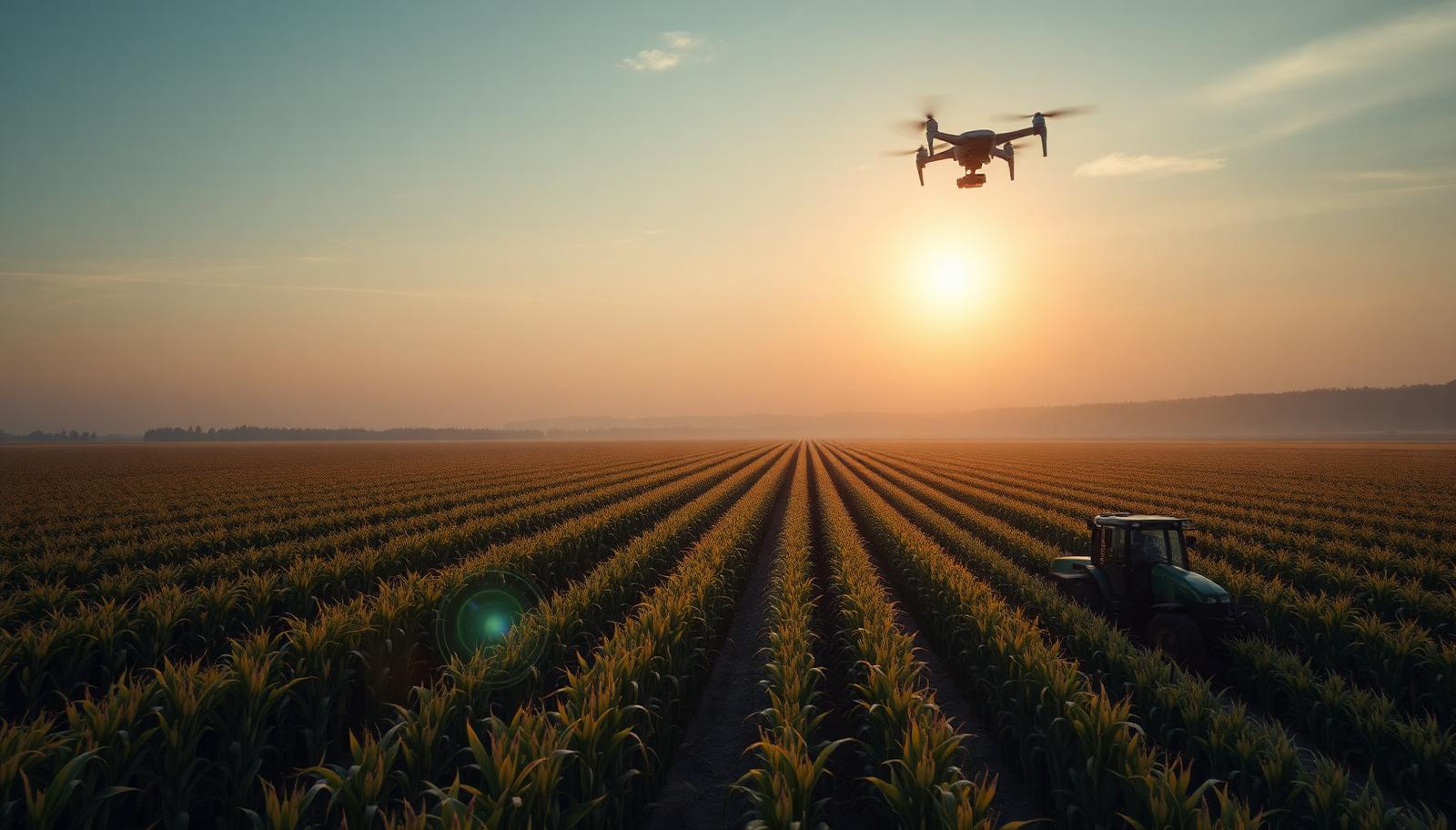
A farmer standing at the edge of a cornfield in 2050 may see the same horizon his grandfather saw — but almost none of the work happening beneath it will be the same.
The soil will still matter. Rain will still matter. Commodity prices, judgment, timing and hard work will still decide who succeeds.
But the farm itself may run through a network of autonomous equipment, artificial intelligence, satellites, sensors and robotic systems that watch each plant, predict machine failures and offer advice around the clock.
Traditional farming in the United States is unlikely to disappear over the next 25 years. Instead, it will slowly become more precise, more automated and more financially advanced.
The change will not happen all at once. It will happen in stages. Here is a realistic look at how American farming may evolve in five-year steps between now and 2050.
2026–2030: AI Becomes a Practical Farm Tool
Over the next five years, artificial intelligence will likely move from an interesting experiment to a normal part of farm management.
Many farmers already use GPS guidance, yield monitors, satellite images and digital records. The next step will be linking those systems through software that can read the information and suggest actions.
AI tools may help farmers make choices about:
- Planting dates
- Crop rotations
- Input purchases
- Fertilizer applications
- Weather risks
- Machine maintenance
- Commodity marketing
- Cash-flow planning
- Crop insurance
- Farm financing needs
The biggest change may not be fully self-driving farms. It may be the ability to pull data from many different systems into one simple dashboard.
Precision Agriculture Becomes More Accessible
Large farms have used precision technology for years. Cheaper sensors and better software may soon make these tools practical for midsize and smaller farms too.
Variable-rate applications will likely become normal, letting producers apply seed, fertilizer and crop protection only where each zone of the field needs them. Camera-guided sprayers that spot weeds and treat only those weeds may also spread quickly.
Farm Financing Implications
Early investments may be software subscriptions, upgraded displays, sensors, connectivity and precision attachments — not full equipment replacement. Producers will need to decide which tools save real money and which are simply expensive features.
Farm lenders may increasingly ask borrowers how a proposed technology investment will:
- Reduce labor
- Improve yields
- Lower input costs
- Protect margins
- Strengthen cash flow
The strongest farms will not be the ones that buy the most technology. They will be the ones that invest carefully and measure the return.
2031–2035: Autonomous Equipment Goes Mainstream
By the early 2030s, autonomous farm equipment may become common on larger row-crop operations and more available to midsize producers.
Instead of one big tractor with one driver, some farms may run several smaller autonomous machines working together. These machines could:
- Prepare seedbeds
- Plant crops
- Apply fertilizer
- Control weeds
- Scout fields
- Move harvested crops
- Work overnight
- Return on their own for fuel or charging
People will still be involved, but their job may shift from driving equipment to overseeing several machines from a central spot.
The Farm Workforce Begins to Change
Farm labor shortages are unlikely to vanish. Automation may be adopted not only to cut costs, but also because farms cannot reliably find enough skilled workers.
Future farm employees may need skills in equipment diagnostics, robotics, data management, software, electrical repair, agronomy and remote fleet supervision. Traditional mechanical skill will still matter, but farms will compete for workers who understand both machines and digital systems.
Livestock Technology Expands
Livestock operations may use more wearable monitors, automated feeders and camera systems. These tools could catch illness, temperature changes, low feed intake, mobility problems, breeding cycles and stress signals early — improving animal welfare while lowering treatment costs and production losses.
Farm Financing Implications
Autonomous equipment will need significant capital. Loan structures may need to reflect the fact that technology becomes outdated faster than traditional tractors and combines. A machine may still work mechanically for many years while its software or sensors are already obsolete.
Borrowers and lenders may pay more attention to resale value, manufacturer support, software update policies, repair access, subscription costs, cybersecurity and how well the system connects with other equipment.
2036–2040: Farms Manage Individual Plants and Animals
By the late 2030s, precision agriculture may move past managing fields by zone. Technology may let farmers manage each plant.
Cameras, drones and field robots could constantly check every plant for nutrient shortages, water stress, weed pressure, disease, insect damage, growth rate and yield potential. Instead of treating an entire field the same way, robots may apply a small amount of fertilizer, water or crop protection exactly where it is needed. This could lower input costs and environmental impact while improving efficiency.
Smaller Robots May Support Heavy Equipment
Large tractors are efficient, but their weight can pack down the soil. Smaller autonomous machines may do repetitive work with less pressure on the ground. A fleet of light robots can keep working even if one unit needs repair — reducing the risk that comes from depending on a small number of very expensive machines.
Drones Become Everyday Farm Infrastructure
Drones may act less like occasional camera tools and more like permanent farm employees. They could be scheduled to inspect fields each morning, watch livestock, check fences, spot standing water, find broken irrigation, map storm damage, locate sick animals and apply very targeted treatments. Some farms may keep automated drone stations where aircraft recharge, upload data and launch again with no human help.
Farm Financing Implications
Farm balance sheets may start to include assets that look more like information technology than machinery. A big part of a farm's productive power may depend on proprietary software, stored data, communication networks, cloud platforms, sensors, robots and digital access rights.
This can make collateral harder to value. A lender can put a lien on a tractor, but the value of a connected farm system may depend on subscriptions, licenses and vendor support. Agricultural underwriting will need to weigh technological strength along with traditional financial strength.
2041–2045: Predictive Farming Replaces Reactive Farming
By the early 2040s, the most advanced farms may run on predictive systems. Instead of finding a problem after it hurts production, farmers may get warnings days or weeks ahead.
AI could combine past yields, weather forecasts, soil data, plant images, disease patterns, equipment performance, input prices and local market conditions to estimate the chance of a disease outbreak, a machine failure, a water shortage or cash-flow pressure.
Equipment Maintenance Becomes Predictive
Sensors may constantly watch engines, bearings, hydraulics and electrical parts. Instead of a combine breaking down during harvest, the farm may get an alert that a certain part has a high chance of failing in the next 40 hours of use. Replacement parts could be ordered automatically and installed during planned downtime — cutting one of agriculture's most expensive risks: a critical breakdown during a narrow planting or harvest window.
Genetics and Crop Development Accelerate
Crop breeding will likely produce varieties better suited for heat, drought, heavy rain, new diseases, shorter growing seasons, lower fertilizer use and specific regional soils. Livestock genetics may improve feed efficiency, disease resistance and heat tolerance. These gains may not look as dramatic as robot tractors, but they could matter just as much.
Alternative Farm Income Becomes More Established
Some farms may earn a larger share of revenue from things beyond crop or livestock sales — such as renewable-energy leases, water-conservation payments, habitat programs, verified carbon programs, ecosystem-service contracts, data-sharing agreements, specialty production and direct-to-consumer sales. These options will not fit every property, but diversified income can help operations survive commodity price swings.
Farm Financing Implications
Lenders may increasingly review farm data directly, with borrower permission. A loan review could use current information about production, inventory, equipment condition and expected yields — not just year-end financial statements. Strong operations may get faster decisions and more customized loan structures. But this will also raise serious questions about data ownership, privacy, cybersecurity, model accuracy, borrower consent and reliance on technology vendors.
2046–2050: The Farm Becomes an Intelligent, Connected System
By 2050, a highly advanced American farm may run as one connected operating system. The farm manager could oversee land, crops, livestock, machinery, labor, marketing and finances from a single platform.
A typical morning dashboard might show crop stages, soil moisture, livestock health alerts, equipment locations, predicted repairs, irrigation advice, weather threats, input inventory, commodity positions, loan balances, projected cash flow and insurance exposure.
Many routine choices may be automated within limits set by the farmer. Irrigation could turn on when sensors and weather models call for it. A robot could pull weeds without waiting for instructions. A marketing system could alert the farmer when prices hit a set target.
The Farmer Becomes a Systems Manager
The farmer of 2050 will still need agricultural knowledge. But successful management may require an unusually wide mix of skills: agronomy, finance, data interpretation, machinery management, technology buying, risk management, environmental compliance, labor supervision, marketing and cybersecurity awareness. Farming may become less physically repetitive but more mentally demanding.
Fully Automated Does Not Mean Unattended
Even the most advanced farm will still face unpredictable conditions. Storms can destroy equipment. Markets can move fast. Technology can fail. Disease can spread in ways no model expected. Experienced judgment will still matter. Farmers will need to know when to trust an automated recommendation — and when to ignore it.
What Traditional Farming Will Still Look Like in 2050
Even with huge technological change, much of American agriculture may still look familiar. There will still be tractors, barns, cattle, grain bins, orchards, pastures and families working together.
Not every farm will become fully autonomous. Adoption will vary by farm size, commodity, geography, capital access, broadband coverage, management style, labor needs and expected return. Some smaller or specialty farms may use technology in a limited way while keeping labor-intensive practices. Older equipment will remain in service. Farmers will keep repairing machines themselves. Relationships with local dealers, lenders, veterinarians, agronomists and neighbors will still matter.
Productive Farmland May Become Even More Important
Technology can improve how land is managed, but it cannot create more productive acreage. Farmland is limited by soil quality, water availability, climate, location, infrastructure and development pressure.
As farm technology gets more efficient, high-quality land may become even more valuable because advanced systems can pull greater output from strong natural resources. Poor land will not automatically become highly productive just because it has sensors and robots on it. Technology will amplify the importance of choosing the right property.
Farm Financing Will Play a Central Role in the Transition
The farm of 2050 may be more efficient, but it may also need much more capital. Future investments may include:
- Agricultural land
- Autonomous equipment
- Robotic systems
- Irrigation infrastructure
- Renewable energy
- Sensor networks
- Data platforms
- Storage and processing facilities
- Cybersecurity systems
- Advanced livestock facilities
Producers will need to balance innovation with financial discipline. A technology investment should be judged by whether it improves cash flow, reduces risk or increases long-term property value.
The most important questions will still be familiar: How will the investment be repaid? What happens during a weaker year? Does the operation have enough liquidity? Is the expected return realistic? Will the asset hold value? Does the loan term match the useful life of the investment? Technology will not remove the fundamentals of agricultural credit — it may make them even more important.
The Future Farmer's Greatest Asset Will Still Be Judgment
A computer may process more information than any person. A robot may work longer hours. A satellite may see problems invisible from the ground. But technology cannot fully copy the judgment built through years of managing land, weather, animals, employees, markets and financial pressure.
The most successful farmers of 2050 will not simply be early adopters. They will be disciplined adopters — people who know which technologies deliver real value, which risks cannot be automated and when experience beats an algorithm.
Frequently Asked Questions About the Future of American Farming
Will robots replace American farmers?
Robots are more likely to replace certain repetitive tasks than to replace farmers. Human judgment, planning, financial management and responsibility will still be needed.
Will all farms be autonomous by 2050?
Probably not. Adoption will vary by farm size, commodity, location and access to capital. Many farms will mix automated and traditional practices.
Will traditional tractors disappear?
Large equipment will likely remain important, especially for broad-acre farming. But it may increasingly run autonomously or work alongside smaller robots.
How will artificial intelligence be used in farming?
AI may help farmers analyze weather, crop conditions, machine performance, marketing opportunities, financial information and production risks.
Will farming need fewer employees?
Some repetitive jobs may decline, but farms may need more workers with technical, electrical, robotics and data-management skills.
Will farmland remain valuable?
Future value cannot be guaranteed. But productive farmland will stay a limited resource that is essential to food, fiber and energy production.
How will farmers pay for new agricultural technology?
Producers may use retained earnings, equipment financing, operating lines, leasing and long-term farm financing. Investments should be backed by realistic savings or added income.
Preparing Today for the Farm of 2050
The future of American agriculture will not arrive with one invention. It will grow out of thousands of small decisions made by farmers, landowners, equipment manufacturers, researchers, lenders and rural communities. The transition has already begun.
The farms best prepared for the next 25 years may be those that invest in strong land, reliable infrastructure, sound financial management and technology that solves real problems.